

A store built around how Saudis actually shop.
KryticalStyle is a Saudi casual-luxury apparel label: oversized tees, hoodies and matching sets, designed and produced locally. We built its whole online business: the bilingual store customers buy from, the commerce engine behind it, and the Arabic admin panel the team runs orders, stock and shipping from.
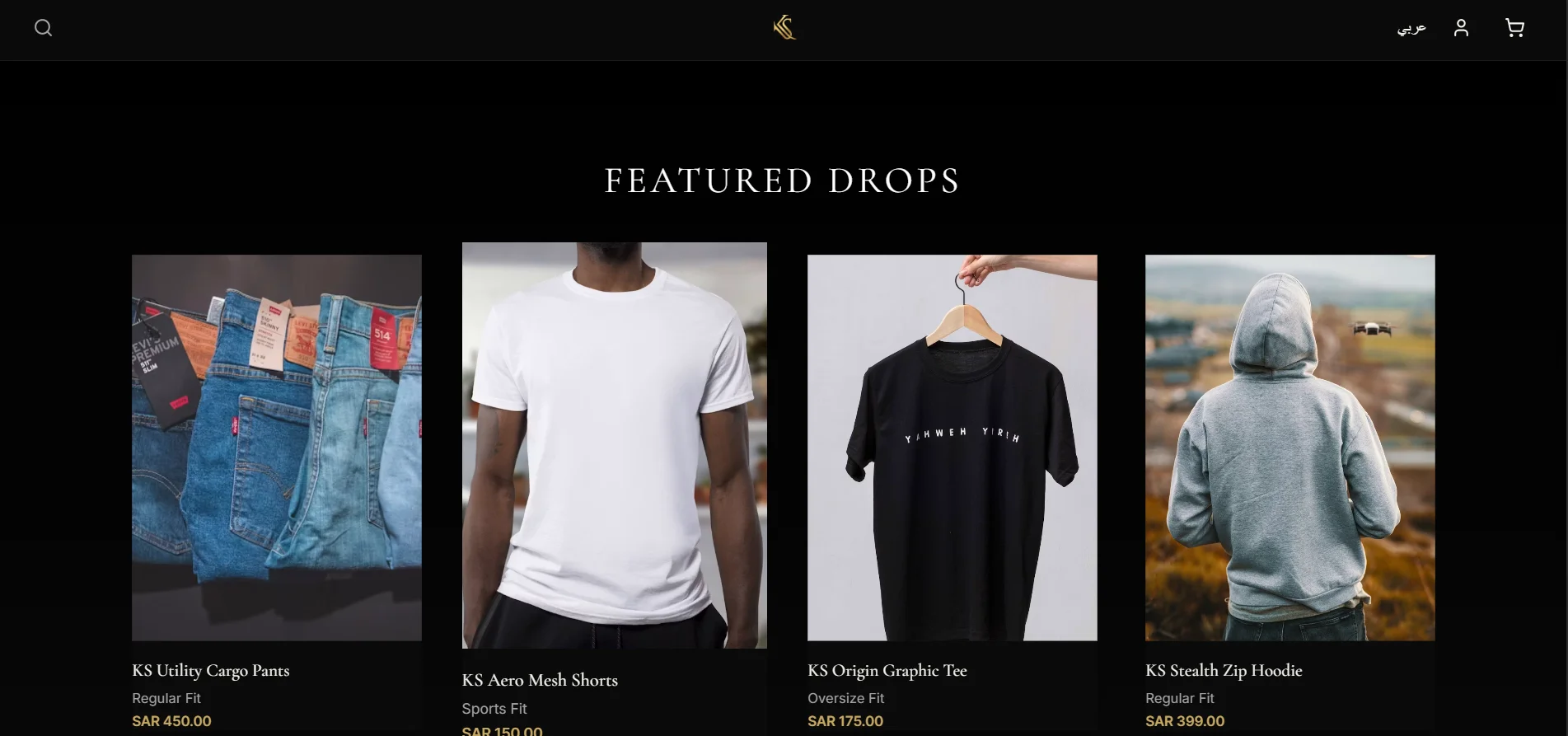
The brand needed its own store, not a rented theme.
KryticalStyle sells premium basics at SAR 250 a tee and SAR 500 a set. At that price the store has to look like the brand, and it has to handle everything a Saudi order involves without the team doing it by hand.
Paying has to feel local
Saudi shoppers expect mada and Apple Pay, many split the price with Tamara, and plenty still want to pay cash when the parcel arrives. A store with only a card form loses them at the last step.
Addresses go wrong easily
Deliveries run on the Saudi National Address. Customers type their short code with spaces, hyphens or Arabic digits, and a wrong address means a parcel that comes back.
The stock is in Aramex's warehouse
Products are stored and shipped from an Aramex warehouse. The store has to know what is really on the shelf, and every order has to reach the warehouse without anyone re-typing it.
VAT shown the Saudi way
Prices must include 15% VAT, and the cart has to show the breakdown clearly, so the price a shopper sees is the price they pay.
Four parts, built as one system.
What the customer sees, what the team uses, and the work that happens between them.
The shop, in Arabic and English
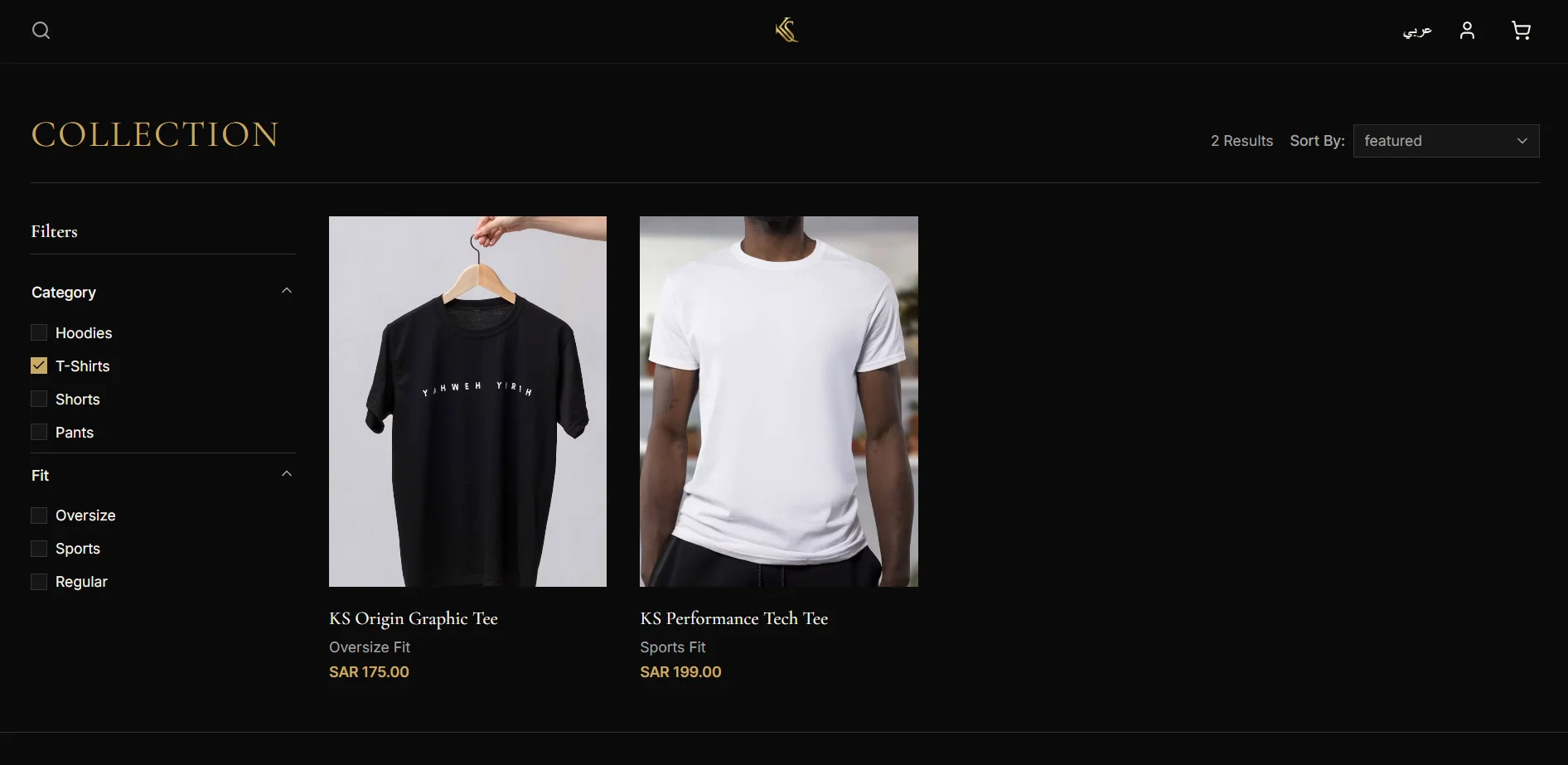
A collection filtered by category and fit, product pages with a size guide, a zoomable gallery and Tamara's instalment preview under the price, and sets that can be bought whole or one piece at a time, each at its own price. The homepage opens on a brand film that never blocks the way into the shop.
Contact, address, payment
Guests can buy without an account. The address step turns a National Address short code into a full address, then asks the customer to confirm a pin on a map, which is what the courier receives. Payment offers mada, cards, Apple Pay on Apple devices, STC Pay, Tamara and cash on delivery.
An Arabic control room
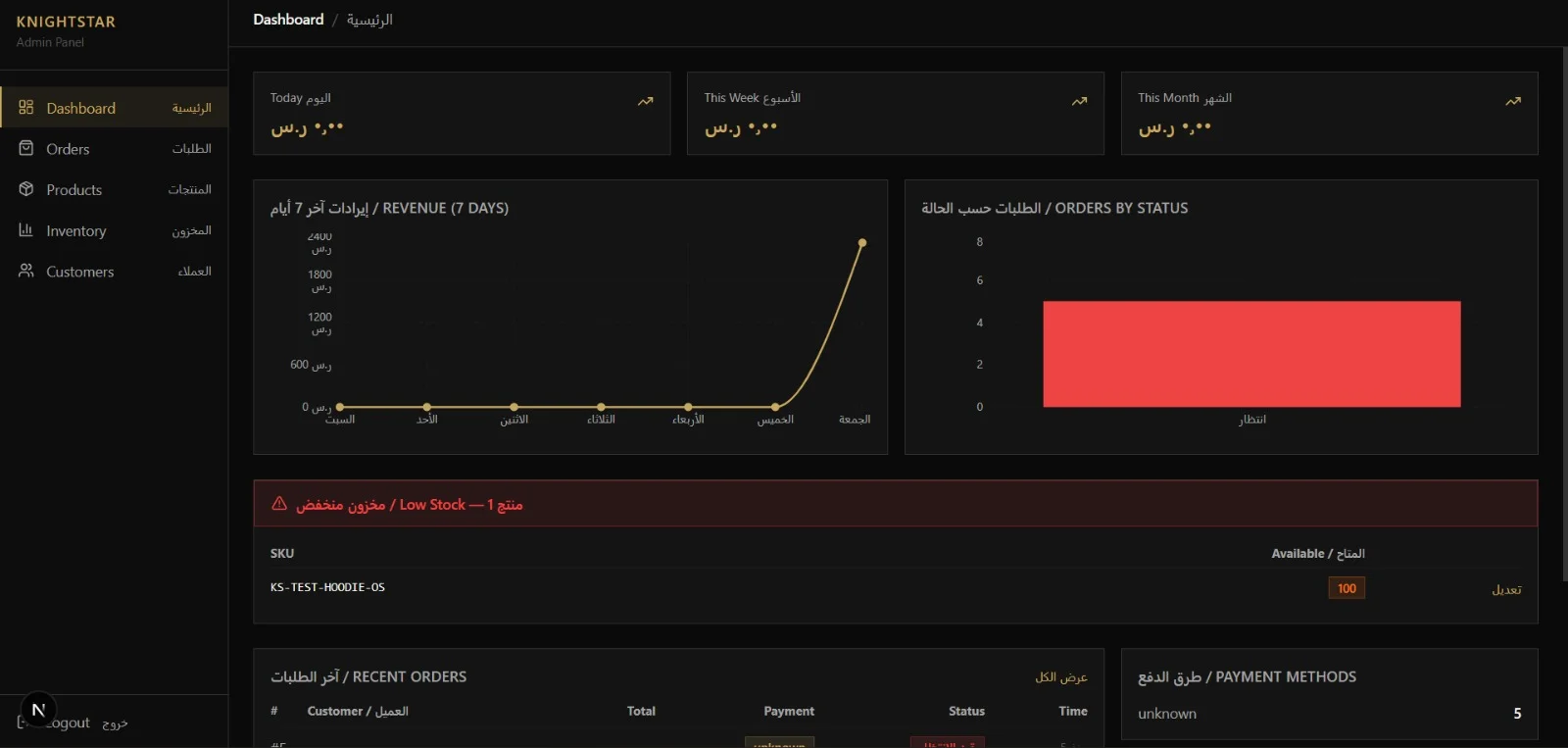
Dashboard, orders, products, inventory, customers, shipping, the Aramex warehouse, and a homepage editor to choose what is featured. A returned parcel can be closed out properly: the order is cancelled, and the stock goes back on sale and is checked.
Jobs that run on their own
Abandoned-cart reminders (one email per person, however many carts they left), Aramex tracking, warehouse stock sync, releasing stock held by unfinished payments, low-stock alerts, and payment reconciliation.
A custom storefront on a proven commerce engine.
The design is fully the brand's own; orders, payments and stock run on Medusa, extended with the Saudi pieces it doesn't ship with.
What people use
- Next.js 16 · React 19 · TypeScript, with next-intl for Arabic and English routes
- MapLibre on CARTO vector tiles for the delivery pin, with a raster fallback for phones without WebGL
- Cloudflare R2 for product photos, resized to 400px and 800px WebP so phones don't download full images
- Google Consent Mode v2: analytics stay in denied mode until the customer chooses
- A separate Next.js 15 admin app, in Arabic
What runs the business
- Medusa v2 on Node.js, PostgreSQL and Redis
- Custom payment providers for Moyasar (mada, cards, Apple Pay, STC Pay) and Tamara, plus cash on delivery
- HERE geocoding to resolve National Address short codes
- Aramex shipping and warehouse (WMS) APIs
- Meilisearch for search, Resend for emails in the customer's language
Decisions that protect the order.
Most of the engineering went into what happens when something goes wrong.
The browser never sets the price
Card and Tamara payments are created from the cart the server priced, not from a number the page sends. An order only completes on a paid or authorised payment, and a reconciliation job catches payments whose customer closed the tab before coming back.
Cash on delivery, with a clear limit
Aramex collects up to SAR 3,750 per shipment, so cash on delivery is only offered below that. Above it, the customer is told to pick another method instead of hitting an error they can't fix.
A failure never ends the order
If the brand film fails to load, the shop is still one tap away. If a short code isn't found, the customer types the address and drops a pin, and the order still goes through.
Designed to feel expensive — without ever being loud.
A restrained palette, a high-contrast type pairing, and Arabic typography that genuinely matches the geometric rhythm of the Latin set.
Designed to feel expensive.
A brand that runs its own store.
Run from one place, in Arabic
Orders, stock, shipping, returns and the homepage are managed from the admin panel, without asking a developer.
Store and warehouse agree
Aramex's real counts sync into the store, and orders that failed to reach the warehouse are caught and sent again.
Every common way to pay
Mada, cards, Apple Pay, STC Pay, Tamara instalments and cash, all in one checkout that also works for guests.
Ready to grow into e-invoicing
VAT is itemised on every order, and the store already produces ZATCA simplified-invoice data (UBL 2.1 XML and the TLV QR code), so e-invoicing can be switched on without rebuilding checkout.
Have a project that can't use a template?
If you're shipping into the Kingdom of Saudi Arabia and you need engineering that respects your market — let's talk.